"Ooh, so this is how a capacitor looks like!"
Experiment 4 was about Capacitors and RC Circuits. We had simple methods in doing this but very significant results were observed.
Starting off with the capacitors. They're small cylindrical (sometimes rectangular) devices with two wires of different length (the longer one is the positive and the other is negative). They kinda look like those small stuff who'll control your brain if they get inside your nose haha!
Okay. Enough with the nonsense.
The first part was that we have to "dissect" a capacitor. We thought it was easy opening a capacitor, but we were wrong. We destroyed about five or more capacitors, most of them are crushed into tiny pieces that we cannot identify what's inside. I spent most of the time trying to break one correctly, so we had to assign each member of our group the parts of the experiment. Finally, I was able to open one using a wire stripper to hammer the screw driver. And the inside of the capacitor looks like this (ceramic):
The white part is the dielectric which looks like a plastic and the grey part was the metal foil. The rolled into concentric cylinders. However, when we opened the carbon capacitor, it has cottony-like substance on it and black powder, which I think is carbon.
Off with the RC Circuits!
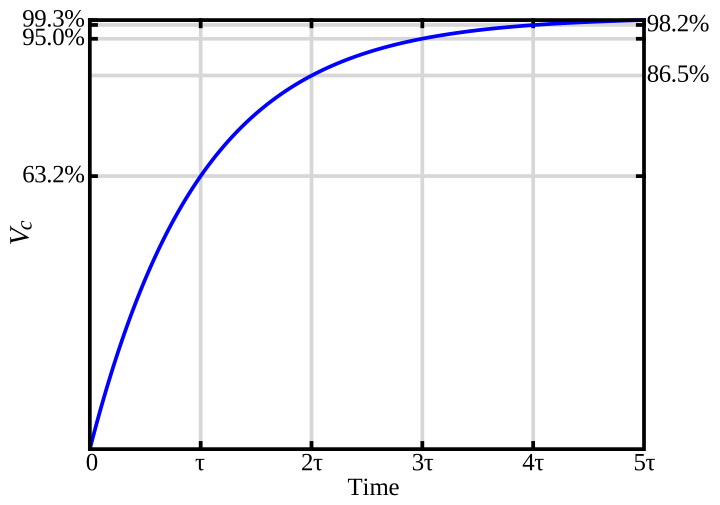
This part had two sub-parts: charging the capacitor and discharging the capacitor. To charge the capaciotr, we had to connect a resistor in series with the capacitor, and then make a current flow through it with a power source. We used the ever awesome Vernier LabQuest to measure the potential difference across the capacitor with respect to time. When measuring device is reading a constant voltage, we then disconnect the source and closed the RC circuit and continued the run.
After a few trials, we observed something like this:
From our 102 lecture class, the time constant tau, is equal to RC. This is the time taken for the charging (or discharging) current (I) to fall to 1/e of its initial value (Io).[1] This time constant corresponds to how progressively slower the charging and the discharging is.