Monday, December 12, 2011

Heaaaaaaaat Engine!

This time we had a relatively very fast experiment. We used the heat engine apparatus, a 100-g weight, hot and cold water bath, and gas pressure and thermo sensor. We connected all of these like the one below:


Apparently, upon making our technical report on this experiment, I found it hard to do. At first I was amused by the going up and down of the heat engine's piston. However, when I read the manual, there were many steps we had to do to interpret the data we had. The experiment itself was easy and fast. We have to first put the metal cylinder into the cold reservoir, note measurements, add weight, note measurements, put into hot reservoir, note measurements, remove weight, note measurements, put into cold reservoir, note measurements, and then the cycle is done!

Though we did it about twice or thrice because we have to read the temperature, pressure and volume simultaneously at each part of the cycle. Once the measurement suddenly deviates, we have to do it all over again. It was fun though!

Well, going back to writing the paper, it was sort of a long process -- maybe because of the guide questions we had to answer that made it hard.

Tuesday, December 6, 2011

Water, Ice, Water

Soooo, we did the the freezing and melting experiment on the 4th meeting of our Physics 103.1 lab class. It was quite a easy-to-do and fast experiment compared to our previous activities. On the other hand, I was extremely late that day... *sigh* I woke up 9AM whereas our lab class starts at the same time. Good thing I was still able to manage and take a bath and run all the way to NIP and end up 30 minutes late.

The Experiment
Going back to the experiment, we started with freezing water. We first took a test tube with around 5ml water and placed it on an ice bath using a iron stand just like the figure below:

this is the exact diagram of what we did in the lab!
Using awesome LabQuest, we measured the temperature of the water inside the test tube with the Thermo Sensor dipped on it. When the ice cubes on the beaker started melting, we added salt to further lower the temperature and continuously added more ice. We did this for 15 minutes. After that, we end up with a constant temperature of 0 degrees Celsius.

When set run 2 and this time, we removed the ice bath and let the ice formed inside the test tube melt. After 12 minutes, we submerged the test tube to a warm water bath. When the run automatically stopped, we were then set to analyze the data.

We then took the average of the flat parts of the two temperature vs. time graphs (which means they're constant). We came up with 0.12 degrees Celsius as the freezing point and 0 degrees Celsius as the melting point. Which is just close enough to the theoretical value.

Personal Insights
It was really, really simple. This experiment was quite straightforward, however, it was really hard to freeze the water... to actually make it solid ice. So we had to do it thrice (I think). Anyway it was literally cool to freeze water. Even though I came late, our group was still able to finish first, which is also a first. :))

Saturday, December 3, 2011

Heat transfer!

Our second experiment was about investigating the heat transfer of water in an unpainted and painted (black) aluminum cans. We did two activities: one for cooling and another one for heating. The latter part was supposed to be an additional experiment, but we still had enough time to do it. :)

I. Heat Transfer for Cooling

We heated water until it temperature almost reach its boiling point. Then, we measured them to 200mL using graduated cylinders and transferred the water onto each can. Using Thermo Sensors and LabQuest, we recorded the temperature in the water inside both cans as they cool down in room temperature.

The graph we got was curved. After further analysis, we concluded that the rate of cooling is directly proportional to the temperature difference inside and outside the can. It was also observed from their polynomial trendlines of degree 2, that the unpainted can cools faster.


II. Heat Transfer for Heating


Each can was then replaced with tap water of the same volume. We then placed them in front of an incandescent lamp. Using the same device, we plot the temperature of each can for 20 minutes. The result came out with a linear a graph, which means that the rate of change in temperature in both cans is constant. By looking at the last temperature recorded, it was obvious that the aluminum can painted in black became hotter than the unpainted one. Computing for the slope of the graphs using trendlines, we also saw that the black can heats faster.

III. Personal Insights
For this experiment, it was sort of a test of patience - waiting for 20 minutes for two cans heated by a lamp. T'was kinda funny how we spent our time while waiting for them:
yeap, we're bored :p
However, putting the almost-boiling-water-it-hurts-when-it-touches you was a challenge, especially when the pot holders are kinda tearing off. :)) Over-all, we had good results and fun lab class by trying to capture people's faces (haha!)

Monday, November 28, 2011

Gas Law

Since the equipment and materials needed for our experiments were not enough for everyone, different activities were then given to each group. Assigned to us was Gas Laws, which means we had to verify Boyle's Law and Charles' Law experimentally.

First off, we took the equipment and materials needed for our experiment. By trial and error (well, error didn't really happened), we were able to figure out how to use them.

I. Boyle's Law

While the temperature kept constant, a syringe was used to change the volume of the air, which in turn, also changes the pressure. The change in pressure is read using Gas Pressure Sensor. The syringe was pushed down by 1 milliliter and the pressure was observed to be increasing.

II. Charles' Law

For this part of the experiment, pressure is kept constant because the gas was allowed to change in volume with the change in temperature. A hotplate was used to raise the temperature of the water close to its boiling point. A digital thermometer was used to determine the change in temperature, whereas a "heat engine" (which has calibrations on it) was used to measure the change in volume. In this case, the gas inside the metal chamber in water bath was cooled by adding small chunks of ice to the water. We observed the moving of the piston of the heat engine upon adding ice.

After the two experiments, we recorded the measurements we had.

III. Personal View
It was really fun doing the experiments when you have fun people to work with and those same people have also the patience to try again when a trial fails.

We did the whole experiment twice due to many errors: (1) the pressure reading is not consistent when the syringe is pulled and then pushed, (2) the volume of the gas inside the heat engine wouldn't change after collecting only five data points, and (3) the water was not heated close to 100 degrees Celsius.

However, my groupmates were patient enough to do them all over again, and we still have a long time left to work. We were then able to get the correct values and we got the correct trend.

And yes, the air followed the Gas Laws with small deviations, because obviously, it is not an ideal gas.

Saturday, November 26, 2011

Welcome Physics 103.1!

Well yeah, I'm in my second semester of my second year in College and it's really exciting!

New experiments, new experience, new groupmates, and new teacher! :))

Groupmates!

  • Dumigpe, Art
  • Garcia, Third
  • Pasion, Pam
Lab Instructor: Mr. Jorge Michael Presto


I'm Looking Forward to this Lab Class! :)

Saturday, October 15, 2011

Bye 102.1!

Aww. so the course is done. :(

We just finished our practical exam which was really fun (because it was answerable enough) and our creative work presentation which I think, went really well.

Soooo, I'll keep updating this blog whenever my thoughts come in place. ^_^ It was really fun remembering those experiments we did and actually realizing that I did learn something by figuring things out in the lab. I'll also miss the lax atmosphere of it. The 'just-right' class that won't make you become extremely stressed out and gives us the opportunity to figure out and discover things through observing. It was not a spoon-fed class, nor a "go-figure-it-out-we-won't-give clues" class. 

I know it's late but I haven't finished my blog to the last experimetn during the deadline, but still, I want to finish this: for self-fulfillment and future reference.

Things will never be easier in college, especially with the course I'm taking. But with these simple (not for me) things we learned, we're ready to go further.

The Experimental Two Capacitor Paradox

Yeaap! This is our creative work, but we didn't study about the question of loss of energy in connecting two capacitors (one charged, one uncharged). We just observed the change in the potentials of both components.

We already did another experiment three meetings before this idea came out. We were measuring the potential and magnetic field of a solenoid connected to an RC circuit. However, we weren't able to find significant results. For three consecutive weeks, we tried but nothing happened. On last day of 102.1 lab class, I took two capacitors from our set-up and played with it (like those little children playing with their dolls XD) and then a simple thought crossed my mind: What if an uncharged capacitor is connected to a charged one (same capacitance)? Jom and Josh thought that ideally, the one will be charged, and the other will be uncharged, and the charge will go back and forth and will be oscillating all throughout. And poof! we have a new investigatory project! Amazing right? :))

(tbc)

Friday, October 14, 2011

Resonance in Series RLC Circuits


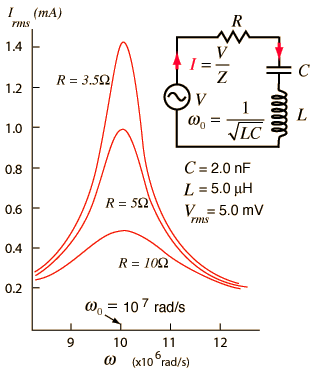
We studied one of the most important circuits used in electronics today. It's an RLC-Circuit with an AC source. These circuits create signals that we use in tuning a radio or making a television reception clearer.

In this experiment, the RLC circuit was tested with different frequencies from the AC source (power supply that oscillates). Using a multimeter, we measured the current and voltage created on the the circuit. (I was hoping that we were going to use the oscilloscope) :(

Same as the graph above, the results were obtained. 

(tbc)

Sunday, October 9, 2011

Electromagnetic Induction

Last experiment we discussed about electric currents creating magnetic fields, now, it is the otherwise. This is explained by:
This states that a change in magnetic flux creates an opposing (denoted by the negative sign, which is described by Lenz's Law) induced current. On the other hand, Lenz's Law states that the direction of any magnetic induction effect is such as to oppose the cause producing it. When the magnetic field increases, the induced current is clockwise, when the magnetic field increases, the induced current is counterclockwise.
Before the experiment, we were taught how to use a galvanometer. Its deflection tells the magnitude of the current induced and its direction. We tested it by connecting it to a power supply, and attached a resistor with large resistance. In this case, we used the human body as the resistor, which was quite amazing to know.

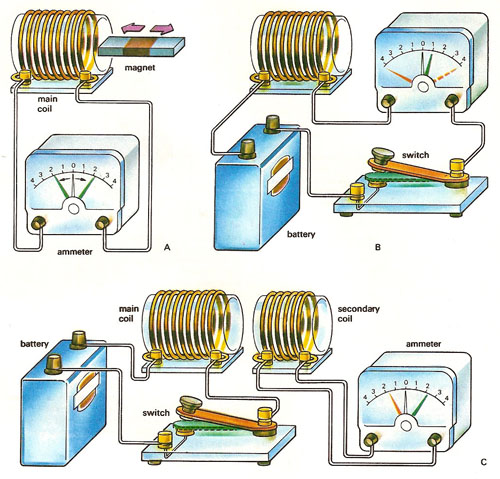
In this experiment, we observed the electromagnetic induction in a solenoid in three different ways:
The figure above shows induction experiments due to (A) a moving magnet (B) varying current (C) decreasing number of turns of the primary solenoid

I noticed that the deflection and magnitude readings of the galvanometer are affected by the following:
  • the speed of the magnet going in and out of the solenoid and when it stops, the meter reads zero
  • the reversing the polarity of the magnet also reverse the deflection of the galvanometer.
  • the distance of the primary solenoid from the secondary solenoid
  • turning the power supply on and off
It was a simple experiment and everything was straightforward.

Where does Magnetic Fields come from?


Our fifth activity was about sources of magnetic fields. Before I thought that these only come from those magnetic metals I used to play with and stick on the refrigerator's door. Until when we had a little experiment in Grade 6 where we wound an iron nail with copper wire and connected it to a battery. "Magically" it attracted all those small pins we had. I was twelve then, and I had no idea why they were like that. My teacher just told me that they were caused by electromagnetic forces.

Now that I'm in college, it was only then I learned that a simple current-carrying wire can create magnetic field. Through this experiment, I was able to understand the magnetic field, and its relationship with electric field.

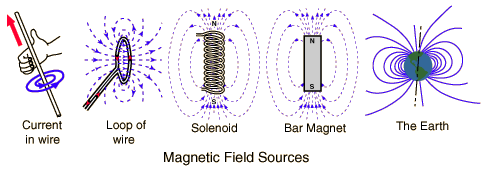
First off, we observed the behavior of magnetic fields in natural magnets We measured the magnetic field strength of a magnet using a sensor. We found out that it is stronger on the poles than away from it. We saw something like the picture above, by putting a sheet of paper over it and sprinkling iron dust over it. Bits of iron aligned with the magnetic field lines. 

Next, we dis Oersted's experiment, wherein we connected a wire to the power source and placed a compass over it. When the switch was closed, the compass needle deflected because the current-carrying wire created a magnetic field. This phenomenon is described by Biot-Savart's Law wherein moving charged particles create magnetic field. In this case, the chraged particles moved in the conductor.


We then observed the magnetic field created by a solenoid: a coil made of varnished copper wire. We made a current run through it, making it an electromagnet. We observed the effect of the number of turns of coil with respect to the magnetic field. We noticed that the values dropped when we lessen the number of coils. This observation verifies the equation derived for solenoids, which is:
There was also an effect when different metals are inserted into the core of the solenoid

It was fun to know that magnetism doesn't only exist in permanent magnets, but also in simple wires that has current on it.


Charged!

"Ooh, so this is how a capacitor looks like!"

Experiment 4 was about Capacitors and RC Circuits. We had simple methods in doing this but very significant results were observed.

Starting off with the capacitors. They're small cylindrical (sometimes rectangular) devices with two wires of different length (the longer one is the positive and the other is negative). They kinda look like those small stuff who'll control your brain if they get inside your nose haha!

Okay. Enough with the nonsense.

The first part was that we have to "dissect" a capacitor. We thought it was easy opening a capacitor, but we were wrong. We destroyed about five or more capacitors, most of them are crushed into tiny pieces that we cannot identify what's inside. I spent most of the time trying to break one correctly, so we had to assign each member of our group the parts of the experiment. Finally, I was able to open one using a wire stripper to hammer the screw driver. And the inside of the capacitor looks like this (ceramic):
The white part is the dielectric which looks like a plastic and the grey part was the metal foil. The rolled into concentric cylinders. However, when we opened the carbon capacitor, it has cottony-like substance on it and black powder, which I think is carbon.

Off with the RC Circuits!

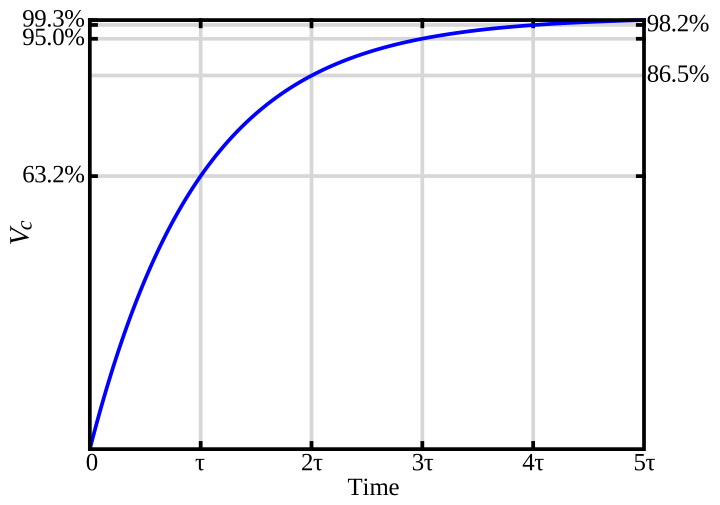
This part had two sub-parts: charging the capacitor and discharging the capacitor. To charge the capaciotr, we had to connect a resistor in series with the capacitor, and then make a current flow through it with a power source. We used the ever awesome Vernier LabQuest to measure the potential difference across the capacitor with respect to time. When measuring device is reading a constant voltage, we then disconnect the source and closed the RC circuit and continued the run.

After a few trials, we observed something like this:

From our 102 lecture class, the time constant tau, is equal to RC. This is the time taken for the charging (or discharging) current (I) to fall to 1/e of its initial value (Io).[1] This time constant corresponds to how progressively slower the charging and the discharging is. 

Tuesday, July 26, 2011

What goes in, must go out.

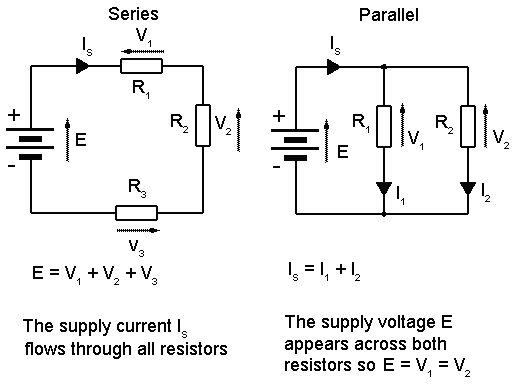
In our third experiment, we studied the amount of Electric Current and Voltage in a circuit where there is a loop. We were able to investigate Kirchoff's Laws, which states that (1) at every junction, the sum of the currents entering must be zero and (2) around every closed loop, the sum of the voltages must be zero.

fig.1 diagram representation of the methods made in doing the expriment
fig.2 diagram representing Kirchoff's Law for Voltages

I honestly didn't know how to connect the resistors on the breadboard. Eventually, but figuring it out by myself, I was able to put them into a loop. Since the law was straightforward, I didn't have any problems with understanding the methods we did. It was quite the easiest experiment we had.


Friday, July 8, 2011

Opposition Offered by One Thing


Yay! at last, I was able to see and touch a resistor. I know it's crazy, well, I didn't have an in-depth discussion and wasn't exposed that much to Electromagnetism.

How to determine Resistance...

We started with reading the resistance of resistors using color bands (which I knew way back in high school) and an ohmmeter. I remember the sentence we used to say to memorize the colors and their corresponding values, "Big Boy Raped Our Young Girls But Violeta Gives Way"

I also learned about different types of resistors (I studied this before, but I have no idea how they really look like in real life, haha!) 

Different types of Resistors

resistor box
Here is a resistance box. Each "screw" is attached to a resistor with their corresponding amount of resistance. When a screw (is it?) is unplugged, the ohmmeter reads a higher resistance. Up until now, I'm trying to figure out how the "screws" affect the resistance.

I also met Rheostat. The adjustable resistor. :))
The scale on top of it affects the length which causes the resistance to decrease/increase.

We also measured the resistance of a variable resistor. When the screw on top is turned, the resistance changes (increases/decreases).

rheostat
variable resistor


Resistors in Circuits


Using the equations provided (and can be derived using voltage and electric current), we were able to observe how resistors affect the electric potential and electric current within a circuit. We also learned that voltmeters are attached parallel to the resistors because it measures across the circuit whereas ammeter are attached in a series connection to the resistors because the electric current flows through the wires.

So that's it! I still have't made the graph of increasing voltage. COMING SOON! :)

Sunday, July 3, 2011

Plotting Electric Potential and Electric Field


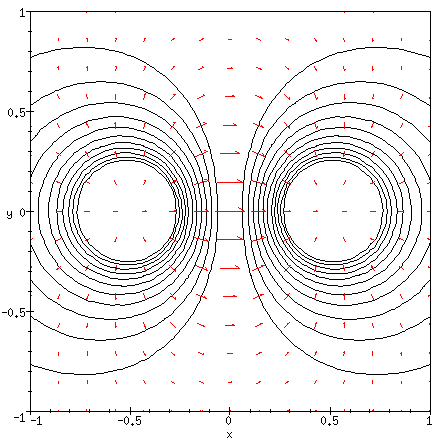
As discussed in the 102 lecture, charged particles or objects possess electric potential and electric field. We then observed this property with an experiment where we have to plot points on the graph that have the same amount of voltage. 

We filled the electrolytic tank with water, then placed the electrodes with wires connected to a power source. Using a voltmeter, we recorded the voltages with respect to their positions on the tank.

I was amused when I connected the points with the same voltage, they were forming a curve, and they were asymptotic to each other. Though, it was really hard to make accurate measurements, because the voltmeter we were using is highly sensitive. When a phone or any object made of metal is close to the set-up, the voltmeter shows a different reading. That's why some parts of our graph were not satisfactory.

Guess who's my new instructor in Physics Lab?

We had our first meeting two weeks ago...

and guess what?

It's Sir Aleo Pacho again! hahaha!

I'm really excited to the lab activites wairting for me this semester, and we've also got new (to me) equipments to handle! yey!

We'll be using oscilloscope, resistors, circuits, and everything else that's related to electromagnetics laboratory!
Hopefully, I do well! :)

Thursday, June 16, 2011

Hello Physics 102.1!

Fundamentals of Electromagnetism and Special Relativity.

So this is the name of the 102 course.

And I wonder if I'm that good in the lab this time. I really don't have a good background in Electromag and Special Relativity. When Dr. Magpantay wrote the course outline on the board, I was... clueless with the words written. Though I know some, but almost all of them were new to me. I have no idea about Gauss' Law... or the AC circuit... I just know the words but the not the concept or whatsoever.

Hopefully, I learn, and absorb, and take them in my grave. haha. kidding!

Looking forward to this sophie life of mine.

End.

Activity 4 (Graphical Analysis of Motion)

This Activity took a long time to finish. First, there was the Best Fit Line discussed by our guest lecturer, Mr. Justine Uro. Second, we made graphs on excel with error bars and trend lines. Third, we gathered data through timing the cart on an air track when it reaches a particular distance. Last but not the least, we made a technical paper about the experiment we did.

Last year, December 8th, We were taught about the Best Fit Line. I haven’t heard of it before, I thought it was just a line that one could by connecting the origin to the mean of the graph. Somehow I was right, but obtaining the mean is not enough. There were many equations to be considered before we could say that it is the "best-fit line", though I wasn't able to remember them all.


We then made an experiment and gathered data. Using Microsoft Excel, we were able to get the trendline and the equation that would represent the relationship of each measurement.

103 measured grains! (Physics 101.1, Activity 3)


We had been doing Activity 3 for two weeks now. Not really two weeks but two meetings. We were not able to do all the measuring last meeting because we had to wait for the other lab class to finish using the calipers and micrometers.
We thought at first that each grain must be measured by a caliper and a micrometer. That means, when the grain is gone halfway of the measuring, we have to get another one. But we were wrong. We were just told to measure rice grains as many as we can.
It was fun measuring stuff when you’re with friends! :D

They’re my group mates. Josh and Ritz

There’s the other group. So serious in measuring but then I said “smile”… haha.

More… other groups… and also concentrating :)

and these are what we’re spending time on… I just hate when I try measuring the length of the rice grain with a micrometer because it falls off easily. This Activity wasn’t just for gathering data, you also learn how to be patient. :)

and here is our record. (i forgot my notebook so we used Josh’s laptop)
We’re going to do more measurements next meeting. Watch out for the updates! :>

Physics 101.1 Activity 2: Error and Error Propagation

Before we had this activity, I thought that error was just a term that means mistake or wrong but after our meeting, I learned that it has deeper meaning when it comes to measurements.
Here are some things that I learned:
1. Error denotes how FAR a measured value with respect to a REFERENCE VALUE.
2. There are two types of error: (a) uncertainty which is the error between trials and (b) deviation which is the error between the measured values and an accepted value.
3. Uncertainty is the absolute value of the difference between the maximum measured value and the mean of the data. It is used for Second Order of Approximation.
4. Deviation is the absolute value of the difference between the mean of the data and the accepted value.
5. Uncertainty happens when something is measured with many trials but with different results. Deviation happens when it has wrong zero reading or the experimental data is taken different from the standard of the accepted value.
6. Absolute Error is the actual absolute difference between the measured value and the reference value whereas Relative Error is a number that describes how large an error value compared to the reference value.
7. Precision - how close the measured values to each other.
8. Accuracy - how close the measured values to the standard value.
9. Precise=Less Uncertainty; Accurate=Less Deviation.
10. It was REALLY easier to describe precision and accuracy through the “dartboard” representation.
11. A measurement is said to be acceptable if the uncertainty is greater than or equal to the deviation.
12. Error propagation happens when a value is obtained not by measurement but by solving using measured quantities.
13. The Principle of Maximum Pessimism states that the error of computed quantities MUST be greater than or equal to error of the individual quantities used to obtain it.
(I found the principle of maximum pessimism funny because I thought of it in a different way. Somehow I thought it meant the greatest pessimistic outlook in life.)
14. Some rules apply for getting Error Propagation such as Addition, Subtraction, Multiplication, Division and Exponents.
I was a bit confused with error propagation but then I found it on the handouts. Maybe I should read it more for better comprehension. :D

Physics 101.1 Activity 1: On Measurement

On November 17, 2010, we had our discussion on Activities 1 and 2.
Activity 1 was entitled, On Measurement. Somehow, it was a recall from what I had in high school. We discussed Significant Figures, Scientific Notations, and orders of approximation. I was a bit confused with the sigfi’s of the final answer when it came from a combination of multiple operations. Good thing it was discussed in the lab class and I was able to get it right. It was the first time I encountered the term “best estimates”. Soon enough, I learned how to do it.
Here are some insights of the first activity:
1. Measurement is IMPORTANT in every scientific endeavor because without it, no theory or law could be proven right.
2. Measuring has a limit, and the exact calibrations that one can take determine the significant figures.
3. Sometimes, when it is just casual talk, it is more convenient to use approximations.
4. Scientific Notations are used for “compressing” very large or very small numbers so that it would be easy to write them.
5. Zeroth Order of Approximation is the same as the order of magnitude. It is known for answering Fermi Questions and is also called back-of-the-envelope-calculations.
6. First Order of Approximation is based on Significant Figures.
7. Second Order of Approximation is also called “best estimates”. It was the average +/- the uncertainty.
8. Third Order of Approximation is on Statistical Treatment. We haven’t discussed this much because there are integrals which we haven’t had in our math subjects.
and that was Activity 1.