
Yay! at last, I was able to see and touch a resistor. I know it's crazy, well, I didn't have an in-depth discussion and wasn't exposed that much to Electromagnetism.
How to determine Resistance...

We started with reading the resistance of resistors using color bands (which I knew way back in high school) and an ohmmeter. I remember the sentence we used to say to memorize the colors and their corresponding values, "Big Boy Raped Our Young Girls But Violeta Gives Way"
I also learned about different types of resistors (I studied this before, but I have no idea how they really look like in real life, haha!)
Different types of Resistors
 |
| resistor box |
Here is a resistance box. Each "screw" is attached to a resistor with their corresponding amount of resistance. When a screw (is it?) is unplugged, the ohmmeter reads a higher resistance. Up until now, I'm trying to figure out how the "screws" affect the resistance.
I also met Rheostat. The adjustable resistor. :))
The scale on top of it affects the length which causes the resistance to decrease/increase.
We also measured the resistance of a variable resistor. When the screw on top is turned, the resistance changes (increases/decreases).
 |
| rheostat |
 |
| variable resistor |
Resistors in Circuits
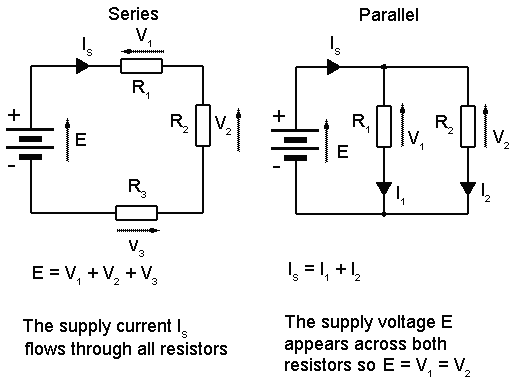
Using the equations provided (and can be derived using voltage and electric current), we were able to observe how resistors affect the electric potential and electric current within a circuit. We also learned that voltmeters are attached parallel to the resistors because it measures across the circuit whereas ammeter are attached in a series connection to the resistors because the electric current flows through the wires.
So that's it! I still have't made the graph of increasing voltage. COMING SOON! :)

No comments:
Post a Comment