Tuesday, July 26, 2011

What goes in, must go out.

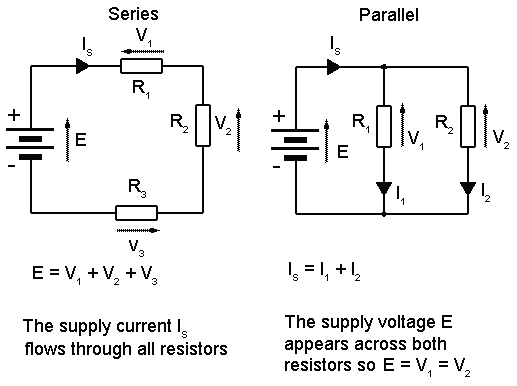
In our third experiment, we studied the amount of Electric Current and Voltage in a circuit where there is a loop. We were able to investigate Kirchoff's Laws, which states that (1) at every junction, the sum of the currents entering must be zero and (2) around every closed loop, the sum of the voltages must be zero.

fig.1 diagram representation of the methods made in doing the expriment
fig.2 diagram representing Kirchoff's Law for Voltages

I honestly didn't know how to connect the resistors on the breadboard. Eventually, but figuring it out by myself, I was able to put them into a loop. Since the law was straightforward, I didn't have any problems with understanding the methods we did. It was quite the easiest experiment we had.


Friday, July 8, 2011

Opposition Offered by One Thing


Yay! at last, I was able to see and touch a resistor. I know it's crazy, well, I didn't have an in-depth discussion and wasn't exposed that much to Electromagnetism.

How to determine Resistance...

We started with reading the resistance of resistors using color bands (which I knew way back in high school) and an ohmmeter. I remember the sentence we used to say to memorize the colors and their corresponding values, "Big Boy Raped Our Young Girls But Violeta Gives Way"

I also learned about different types of resistors (I studied this before, but I have no idea how they really look like in real life, haha!) 

Different types of Resistors

resistor box
Here is a resistance box. Each "screw" is attached to a resistor with their corresponding amount of resistance. When a screw (is it?) is unplugged, the ohmmeter reads a higher resistance. Up until now, I'm trying to figure out how the "screws" affect the resistance.

I also met Rheostat. The adjustable resistor. :))
The scale on top of it affects the length which causes the resistance to decrease/increase.

We also measured the resistance of a variable resistor. When the screw on top is turned, the resistance changes (increases/decreases).

rheostat
variable resistor


Resistors in Circuits


Using the equations provided (and can be derived using voltage and electric current), we were able to observe how resistors affect the electric potential and electric current within a circuit. We also learned that voltmeters are attached parallel to the resistors because it measures across the circuit whereas ammeter are attached in a series connection to the resistors because the electric current flows through the wires.

So that's it! I still have't made the graph of increasing voltage. COMING SOON! :)

Sunday, July 3, 2011

Plotting Electric Potential and Electric Field


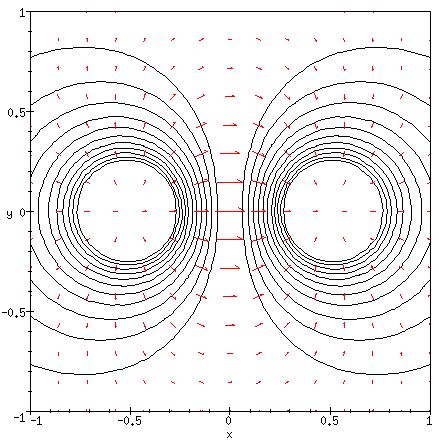
As discussed in the 102 lecture, charged particles or objects possess electric potential and electric field. We then observed this property with an experiment where we have to plot points on the graph that have the same amount of voltage. 

We filled the electrolytic tank with water, then placed the electrodes with wires connected to a power source. Using a voltmeter, we recorded the voltages with respect to their positions on the tank.

I was amused when I connected the points with the same voltage, they were forming a curve, and they were asymptotic to each other. Though, it was really hard to make accurate measurements, because the voltmeter we were using is highly sensitive. When a phone or any object made of metal is close to the set-up, the voltmeter shows a different reading. That's why some parts of our graph were not satisfactory.

Guess who's my new instructor in Physics Lab?

We had our first meeting two weeks ago...

and guess what?

It's Sir Aleo Pacho again! hahaha!

I'm really excited to the lab activites wairting for me this semester, and we've also got new (to me) equipments to handle! yey!

We'll be using oscilloscope, resistors, circuits, and everything else that's related to electromagnetics laboratory!
Hopefully, I do well! :)